Who is ‘M by Jase Lior’?
The camera remembers.
The light forgives.
You belong here.
My first name is really mine, Jase. The rest, I chose.
I kept the L. I just gave it somewhere further to go.
Lior. It means “my light”. I didn’t invent that meaning. I only recognised it, the way you recognise a room you’ve never stood in before and somehow already know.
So I kept looking. Through glass. Through stillness. Through the long, patient seconds a camera holds open when everything else in the world insists on moving fast.
Water forgets to rush. Mountains forget to hide. And somewhere in that forgetting, I found the only kind of photograph worth keeping.
Not staged. Not shouted. Just true.
That’s what M by Jase Lior is built on - one letter, one belief, five quiet forms of light: growth, warmth, ground, clarity, and flow. You won’t find them labelled on the wall. You’ll just feel which one your home has been missing.
I don’t make photographs to be looked at. I make them to be lived with.
Hung where the morning finds them first. Sat beneath, in the one hour of the day that finally feels like yours.
I kept the L. You get to keep the light.
In-Between the Frames
Some things are easier to understand when they’re not explained too much.
-
Before sunrise, I went out with my camera and found a man alone by the river — drinking, smoking and singing.
A nod. A smile. A question about my camera.
And then, unexpectedly he began to talk about loss, trauma and a lifetime of pain.
I listened. Not as a photographer, but as someone who understood that kind of darkness.
I shared some of my own story too. How trauma can shape us, but doesn’t have to define us. How even our darkest experiences can strengthen us, prepare us for a purpose we may not yet understand, and turn our scars into light for someone else. How there can still be light, purpose and people worth holding onto.
We talked from darkness through dawn and into morning. He told me he had never felt heard in quite that way.
There were tears. There was laughter. There were hugs.
I took one photograph. A long exposure, almost by accident.
I went looking for a sunrise. Instead, I found a moment where listening helped someone find a little more light.
Sometimes the photograph isn’t what you came to capture. It’s what you came to understand.
#MensHealth
-
It isn’t a place or a particular photograph. It’s a moment.
A cloud opens. The world seems to pause. One ray of light breaks through — fleeting, unexpected and impossible to recreate.
The irony is, those moments rarely happen when the camera is ready.
For me, making a photograph is almost a meditation — slowing down, becoming still and allowing nature to reveal what it wants to reveal.
Like water, I try not to force it. I’m waiting for the right elements to find each other: the landscape, the clouds, the stillness and that one extraordinary beam of light.
I’m not searching for one perfect moment. I’m grateful for every moment I’m lucky enough to witness.
-
It’s a feeling.
I’ve always seen things a little differently — finding something extraordinary in what might otherwise look ordinary.
Most of the time, I know it the moment I press the shutter. The light, the feeling, the frame — something just clicks.
I trust the moment to speak for itself. I let the light, the landscape and the feeling lead. But sometimes a photograph waits for you — an old digital negative, almost forgotten, can reveal something you didn’t fully see that day.
It’s about noticing what was.
-
One camera. One lens. Enough patience.
I shoot both Nikon and Leica, but I have a particular love for Leica — perhaps because it asks more of me.
Manual focus. Simple controls. Just my hands and the moment. A slower, more deliberate way of seeing.
I don’t like carrying more than I need. One lens is usually enough. The less I have to think about, the more I can see.
My camera is a tool, not the reason I’m there. It gives me the freedom to stay present — to notice when the light changes, when the landscape shifts, or when something unexpected begins to unfold.
Sometimes the best thing I can carry is simply the willingness to wait.
-
Some photographs have travelled further than I ever imagined.
My first landscape of Sydney Harbour in Australia was noticed and featured by the NSW Government — something I never set out to achieve.
Later in 2016, I won the ‘Most Outstanding Image of Connectivity’ category. The photograph went on to become one of three artworks created to help launch a new Sydney precinct.
Those moments meant a lot.
But one of the moments I remember most happened much further from the camera.
My aunt was living overseas and going through a difficult time, so I sent her one of my favourite fine-art landscape prints. Knowing it brought her joy even from the other side of the world, meant more to me than any recognition ever could.
It reminded me why I make these photographs.
If something I create can bring light to someone who needs it, that is worth more than being recognised for it.
-
Some photographs are impossible to recreate.
Not because of the place, but because of everything that happened to be there at exactly the right moment — the light, the people, the feeling, and the life I was living.
At Lake Wānaka in New Zealand, I found a smoky lake beneath an overcast sky with a small opening of light falling perfectly onto one tree. The atmosphere had been created by a Korean production filming nearby — something I could never have planned or ever recreate.
At Lake Bled in Slovenia, I met a stranger the day before who spontaneously agreed to wake before dawn and drive me to the lake for sunrise. The next morning, mist met the shadow of the church roof as the rising sun flared over the cross and spilled across the lake. I often wonder if the photograph would exist at all without that stranger’s kindness.
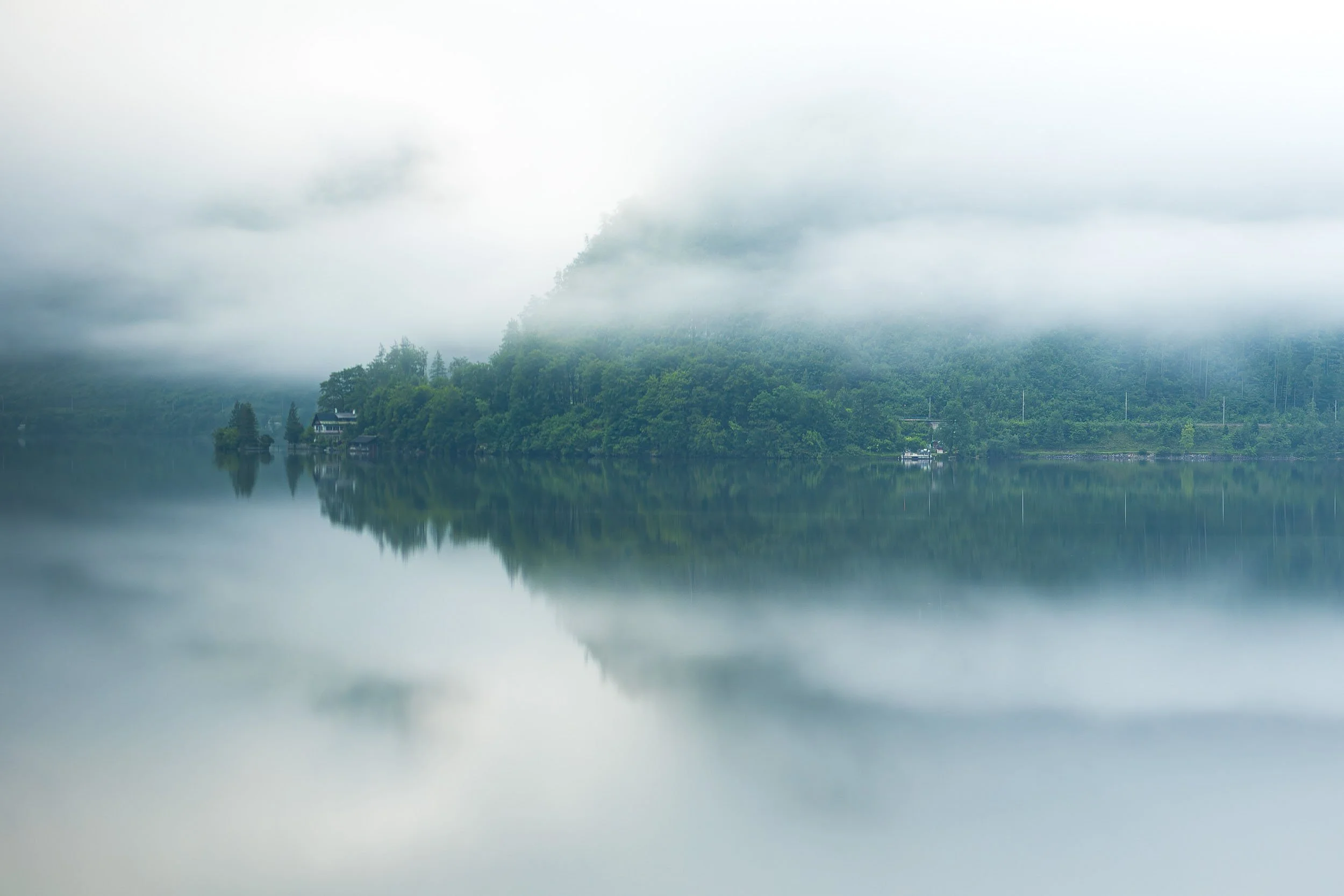
And in Hallstatt, Austria, the other photographers had already left when a low cloud drifted between the mountain and the village, creating something almost otherworldly.
I remember the people I shared these moments with, too — sometimes someone I loved, sometimes a new friend, sometimes a stranger who became part of the story.
That’s why I keep photographs like these close. They don’t just take me back to a place. They take me back to who I was, who I was with, and what that moment felt like.
Some photographs capture a view. The ones I keep capture a life.